Your tax advisor doesn't protect you from the tax auditor
The Misconception: Audits Don't Only Happen at the Tax Advisor's Office
Becoming self-employed happens quickly, and a small GbR, UG, or GmbH is set up in no time. Few founders realize that, in doing so, they automatically take on the following obligations:
- Being able to create, send, receive, and process electronic invoices.
- Archiving all tax-relevant documents and records in an audit-proof, immutable, GoBD-compliant manner.
- Operating IT that seamlessly logs any subsequent changes to tax-relevant records and postings.
- Maintaining process documentation that describes all processes surrounding tax-relevant records and the IT used – down to the IT processes for data backup.
Just as few people know that the tax office can show up unannounced at any time to check compliance with these rules. Many assume that their tax advisor takes care of these obligations, and that the tax office carries out its audits exclusively at the tax advisor's office.
The tax office, however, draws a strict distinction between bookkeeping (at your tax advisor's office) and the creation and archiving of records (within your company). Your tax advisor only books finished records – creating and archiving them remains your sole responsibility. Even as a sole proprietor or GbR, you must expect the tax office to show up at your premises unannounced. For inspections, the tax office has three legal options:
The on-site inspection (Nachschau)
Officials show up unannounced during business hours and check: How are invoices issued? Where are the original documents kept? Is the process documentation actually followed in daily practice?
IT system audit
The GoBD grant the tax office a right of access to your system (Z1/Z2/Z3). Since your tax advisor only sees the posting entries, only you can prove the audit-proof integrity of your upstream system.
Responsibility for primary records
The tax advisor is only liable for correct posting. You are responsible for capturing and retaining the original records – any doubts about their authenticity are always examined at the source: with you.
GoBD Compliance – Achieved Automatically
With MyRecruit.App, you record orders, revenue, invoices, credit notes (invoice corrections), business entertainment expenses and internal expenses through their designated processes – MyRecruit.App takes care of everything else for you: it generates the corresponding record, links it to the posting, archives it in an audit-proof manner, and logs its creation in the audit trail. This only happens once the respective posting is finalized (closed); before that, you can make changes at any time without creating a new document version.

The Audit Trail
Every change to a posting is automatically logged – including a timestamp and user ID. This lets you prove, with a single click, when a posting was created, who created it, and who changed it and when. A requirement that's nearly impossible to meet in a legally sound way with MS Excel or Word. MyRecruit.App maintains this audit trail for all GoBD-relevant information categories. The associated documents cannot generally be overwritten. If an incorrect record was uploaded, it can of course be corrected. MyRecruit.App always creates a new version and logs this in the audit trail.
Process Documentation at the Center of On-Site Audits
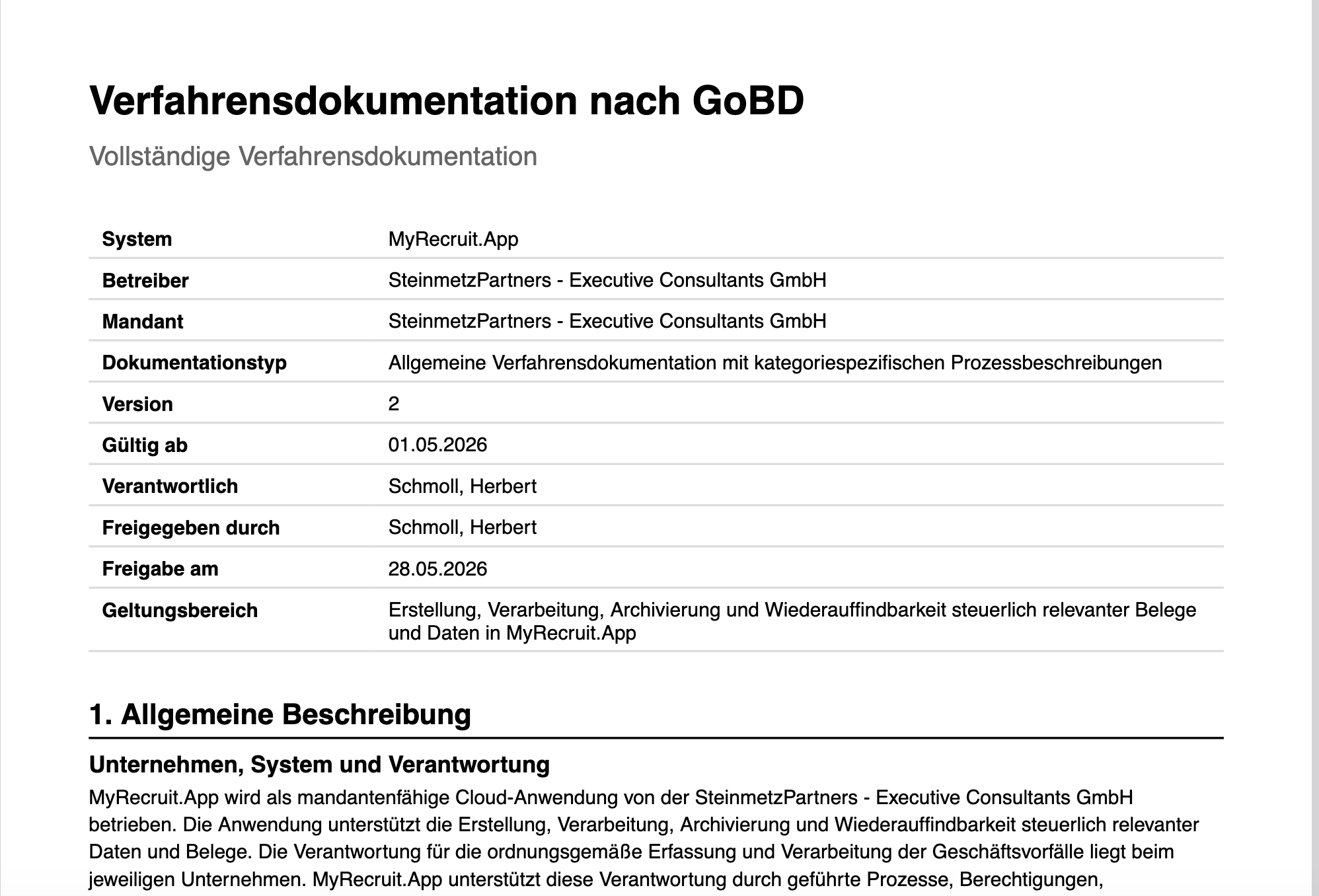
During an on-site audit, the tax office verifies not only whether process documentation exists, but whether the documented processes are actually followed in day-to-day operations. MyRecruit.App delivers this documentation in an integrated way: for every GoBD-relevant category, a GoBD button leads directly to the matching documentation – always complete and up to date.
The documentation always includes all general parts, such as the "General Description" or the "Technical System Documentation." What differs is always the "User Documentation," which always relates to the selected data category (quote, order, invoice, etc.). In addition, the entire process documentation can also be downloaded as a PDF document for the auditor to take along, containing the complete user documentation for all data categories.
Minimum Structure of the Process Documentation
According to GoBD paragraph 153, process documentation generally consists of four parts:
Progressive and Retrograde Auditability
Another key GoBD requirement is progressive and retrograde auditability. In a retrograde audit, it must be possible, starting from a posting, to trace which record or business event it is based on. In a progressive audit, conversely, it must be possible, starting from the record or business event, to trace how it was processed in the books and, if applicable, which postings it flowed into.
MyRecruit.App supports these requirements by generating and processing GoBD-relevant business events and records through the corresponding ERP functions and linking them to the associated postings and documents. This makes it possible to trace the connection between business event, record, and posting in both directions.
MyRecruit.App thereby ensures that the record, posting, and assignment information required for an audit is systematically linked together and traceable for a knowledgeable third party.
The GoBD Ensure Professionalism
All of these obligations naturally also make sense from a business perspective. In this respect, the GoBD compel a certain level of professionalism. And MyRecruit.App gives you that professionalism fully automatically.
The Linked Transaction Chain
The GoBD do not define an independent concept of a "transaction" or "business transaction" as an overarching object under which all documents of a business process must be grouped. The GoBD do not specifically require: "All documents of a project must be grouped under one transaction number."
They do, however, require that business events be traceable and verifiable, and that the emergence and processing of individual business events can be followed without gaps. A knowledgeable third party must be able to gain an overview of the business events and the company's situation within a reasonable amount of time.
To ensure this, it makes technical sense to assign all business events to an overarching business transaction. This means the auditor, for example, doesn't have to laboriously search for the order behind an invoice – all postings and documents that belong together are available with a single click. In this way, the GoBD's requirements for traceability and verifiability are ideally supported in MyRecruit.App through the "business transaction."